Local SEO in digital marketing is the practice of optimizing your online presence so your business appears when nearby customers search for what you offer. It focuses on local results on Google, including the map pack, and it brings calls, visits, and inquiries from people in your area.
This guide explains what local SEO is, how it differs from traditional SEO, which ranking factors matter, and the steps to follow. It also covers AI search, bilingual businesses in Egypt and Saudi Arabia, and when to work with a digital marketing company.
Key Takeaways
- Google Business Profile is the foundation: complete it, verify it, and keep it current.
- Local rankings rest on three signals: relevance, distance, and prominence.
- Consistent NAP (name, address, phone) across your website and listings builds trust with Google and customers.
- Reviews, local content, and local citations strengthen prominence.
- Measure what matters to the business: calls, direction requests, WhatsApp clicks, and conversions, not rankings alone.
What Is Local SEO in Digital Marketing?
Local SEO helps your business show up when nearby customers search for the products or services you offer. It is a focused branch of SEO that improves your visibility in local search results, especially on Google. If your business has a physical location or serves customers in a specific area, local SEO is one of the most direct ways to reach them.
Local SEO Full Form and Meaning
The local SEO full form is local search engine optimization. The term describes SEO work aimed at searchers in a specific city, neighborhood, or region.
Local SEO Examples in Digital Marketing
Search for “coffee shop near me” and Google shows a map with a few top listings above the regular results. That box is the map pack (also called the local pack), and it is one of the most common local SEO examples. Searches such as “mechanic near me”, “dentist in Cairo”, or “clinic in Riyadh” trigger local results in the same way. People who run these searches are usually ready to visit, call, or buy.
Local SEO vs SEO
Traditional SEO competes for visibility with a wide audience, often national or global. Local SEO competes for visibility within a defined place, so location signals carry much more weight.
| Aspect | Traditional SEO | Local SEO |
|---|---|---|
| Target audience | Broad, often national or global | Searchers in a specific city, neighborhood, or region |
| Primary goal | Organic traffic at scale | Visits, calls, and regional leads |
| Where results appear | Standard organic results | Map pack, Google Maps, and localized organic results |
| Main ranking factors | Backlink authority, technical depth, content relevance | Relevance, distance, and prominence |
Types of Local SEO in Digital Marketing
Local SEO is not one task. It is a group of connected workstreams, and most businesses need several of them at once.
- Google Business Profile SEO: optimizing your listing to compete in the map pack and Google Maps.
- Local on-page SEO: location and service pages, titles, headings, and local schema markup.
- Local citations and listings: consistent business details across directories and platforms.
- Reviews and reputation management: collecting, answering, and learning from customer feedback.
- Local content and link building: community content and mentions from local partners and media.
Benefits of Local SEO: Why It Is Important for Small Businesses
A small business that wants to stand out in its area needs local SEO as a core channel. The importance of local SEO in digital marketing shows up in six outcomes. Many of the basic steps are free, such as completing your profile, collecting reviews, and using Google Search Console.
Boost Your Local Visibility Online
Local SEO puts your business in front of people searching for what you offer in your area. Consistent mentions of your business name, address, and phone number across directories, social platforms, and review sites make it easier for potential customers to find you.
Drive More Foot Traffic to Your Store
If you have a physical location, more local visibility means more people walking through your door. Whether you run a coffee shop, a boutique, or a hardware store, local SEO helps nearby customers discover you when they are ready to stop by.
Follow Local Shopping Trends
Consumers are more intentional about supporting businesses in their area. Local SEO places your business in front of them when they search for the services or products you offer.
Attract Traffic That Converts
Local SEO filters out irrelevant clicks by targeting people who are actually in your service area. You get more qualified leads and spend less time on inquiries that never convert.
Earn More Calls and Visits from Google Maps
A well-optimized Google Business Profile helps you show up more often on Google Maps. More visibility there leads to more calls and more customers at your door.
Build Trust as a Local Expert
Valuable local content and earned backlinks position your business as a trusted voice in its field. Blog posts about your neighborhood and collaborations with other local brands deepen your connection with the community and support your rankings.
How Local SEO Works
Understanding how local SEO works starts with three signals that shape local results:
- Relevance: how well your business profile or website matches what the person searched for.
- Distance: how close your business location or service area is to the person searching.
- Prominence: how well known and trusted your business is, based on reviews, ratings, and local backlinks.
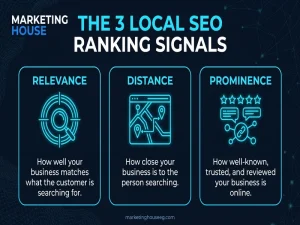
Local results appear in two places. The map pack, powered mainly by Google Business Profile listings, shows a map with the top three business listings. Localized organic results sit below it. A strong local SEO strategy works on both.
Local SEO Ranking Factors You Should Know
Local SEO is about showing up in front of the right people at the right time. Three groups of factors influence how you rank.
Google Business Profile (Formerly Google My Business)
- Business name: use your real business name exactly as customers see it, and keep it identical across your profile and website.
- Categories: accurate categories tell Google what your business offers and increase the chances of appearing for relevant local searches.
- Website link: linking your profile to a strong, relevant page on your website can improve your visibility.
- Photos, posts, Q&A, hours, and bookings: these may not directly influence rankings, but they improve engagement and conversions.
Reviews
- Google reviews: star ratings and detailed feedback posted directly on your profile.
- Third-party reviews: reviews on platforms such as Yelp or TripAdvisor add credibility.
- Website testimonials: reviews published on your own site also count.
Google also considers how recent, frequent, and diverse your reviews are. When you reply, be specific and natural: thank the customer, mention the service they used, and address any problem directly.
On-Page SEO Factors
- Domain and page authority: strong, trusted websites rank better.
- NAP consistency: your business name, address, and phone number must match across your site and Google profile.
- Keyword optimization: include the local search terms your customers use.
- Content quality: well-written, error-free content increases trust and ranking potential.
- Technical performance: a secure, mobile-friendly website with fast load times serves both users and search engines.
Which Local SEO Path Fits Your Business?
Your business model changes where you should focus first. Use this table as a starting point.
| Business model | What it means | Where to focus first |
|---|---|---|
| Single storefront | Customers visit one physical address | Verified profile, accurate categories, reviews, photos, and a clear location page |
| Service-area business | You travel to customers and may not receive visitors | Defined service areas, service pages per area, reviews that mention the service |
| Multi-location | Several branches in different cities | One profile and one unique page per branch, with consistent branding and details |
| Online-only with local customers | No public premises, but you serve a region | Location-focused content, local citations, and local partnerships |
Local SEO Checklist: 9 Steps to Follow
Use this local SEO checklist to guide your next steps. If you are building local SEO strategies for small businesses on a tight budget, steps 1, 2, and 8 cost nothing but time.
- Claim and optimize your Google Business Profile. Complete every field, choose accurate categories, add high-quality photos, and keep your name, address, and phone number consistent.
- Keep your profile up to date. Refresh hours, posts, offers, and answers to common questions on a regular schedule.
- Create location- and service-specific landing pages. Build a dedicated page for each city, neighborhood, or service you target. Clear page structure helps these pages convert, as covered in our guide to landing page UX best practices.
- Research local keywords. Combine your core service with a city, neighborhood, or “near me” intent, then use those terms in page titles, meta descriptions, and headings. A simple pattern is “Service in City | Brand”.
- Add local schema markup. LocalBusiness structured data helps search engines identify your address, business hours, and other operating details.
- Make your website fast and mobile-friendly. A slow mobile experience weakens the effect of your other local SEO work.
- Research your local competitors. Review how top competitors rank, which keywords they target, how their reviews look, and where their backlinks come from.
- List your business in local directories and citation sites. Keep your name, address, and phone number identical everywhere, including Bing Places and other relevant directories.
- Publish local content and engage your community. Share locally relevant guides, case studies, and community updates. Sponsor events, collaborate with local organizations, and earn mentions and links from local media and partners.
Google Business Profile Optimization Checklist
Your Google Business Profile, formerly Google My Business, is the foundation of local search marketing. A complete, accurate profile helps your business appear in relevant local results, drives more traffic to your website, and turns nearby searchers into customers.
| Profile Element | What to Do |
|---|---|
| Business information | Claim and verify the profile. Keep your name, address, and phone number identical to your website. |
| Categories | Choose accurate categories that describe what your business offers. |
| Website link | Link to a strong, relevant page on your website. |
| Hours | Keep opening hours current, including holidays. |
| Photos | Add high-quality photos of your business, team, and work. |
| Posts and offers | Publish updates and offers regularly to show the profile is active. |
| Q&A | Answer common customer questions. |
| Reviews | Ask for reviews after each service and respond to all of them, including negative feedback. |
Local SEO for Bilingual Businesses in Egypt and Saudi Arabia
In Egypt and Saudi Arabia, many customers search in Arabic, English, or both. A local strategy should reflect that instead of copying a single-language playbook.
- Match your business details in both languages. Use one agreed spelling of your business name, and write the address and phone number the same way on your website, profile, and directories.
- Cover both search languages. Create Arabic and English versions of key service and location pages, and use city names customers actually type, such as Cairo, Alexandria, Riyadh, or Jeddah.
- Check how your address appears. Confirm that your address format is clear and identical in every listing, and verify local formats, such as the Saudi National Address, with an official source.
- Make contact easy. Add a clear call button and a WhatsApp link where it suits your customers, then track clicks on both (see the measurement section below).
Treat these points as a checklist to verify for your own market, not as fixed rules. Search behavior changes by city, industry, and audience.
Local SEO and AI Search: What to Expect in 2026 and Beyond
People now ask AI tools such as Google AI Overviews and AI Mode for local recommendations, and voice assistants answer “near me” questions directly. These tools draw on business data that is accurate, consistent, and well reviewed, so the same fundamentals still apply:
- Keep your business details identical across your website, profile, and directories.
- Collect detailed reviews that describe the service and the location in plain language.
- Add LocalBusiness schema and keep your website content specific about where you work and what you offer.
- Publish clear answers to the questions customers ask, in a format that is easy to quote.
No one can promise a specific result from AI search, so focus on accuracy and trust, and review your visibility regularly.
How to Measure Local SEO Results
Tracking shows which actions work. Google Search Console reports how your pages perform in search, and Google Analytics shows what visitors do after they arrive. Rank tracking for Google Maps and Google Search shows where you appear for your local keywords. The outcomes that matter most to the business are calls, visits, and conversions.
- Tag your profile link. Add UTM parameters to the website link on your Google Business Profile so Google Analytics can separate profile visits from other traffic.
- Track actions, not only positions. Watch calls, direction requests, website clicks, and WhatsApp clicks as the main signals.
- Review on a schedule. Compare results monthly and adjust your pages, profile, and review process.
For a walkthrough of checking positions, read our guide on how to find keyword ranking in Google.
Common Local SEO Mistakes to Avoid
Many businesses miss local opportunities because of avoidable mistakes. These are the most common ones and how to fix them.
Mistake 1: Ignoring Local Keywords
Keywords determine where your content appears in search results and whether it appears at all. If your website, Google Business Profile, and directory listings lack relevant local keywords, you miss valuable traffic and leads.
Mistake 2: Neglecting Reviews
Reviews influence buyers and they also affect how search engines rank your business. A profile with no reviews looks inactive, and unanswered negative feedback can damage your reputation. Ask customers for reviews and reply to each one.
Mistake 3: Choosing the Wrong Categories and Attributes
Your business category and attributes tell Google what you do. Irrelevant or incomplete choices confuse the algorithm and your potential customers.
Mistake 4: Skipping Visual Content
Photos and videos provide context, build trust, and drive engagement. Listings without visuals often lose out to more complete profiles.
Mistake 5: Letting Business Information Drift
Outdated or inconsistent names, addresses, phone numbers, or hours confuse search engines and customers. Review your website, profile, and directory listings regularly so they all match.
Local SEO Services: Do You Need a Digital Marketing Company?
Many small businesses start local SEO on their own. A digital marketing company that offers local search engine optimization services takes over the ongoing work: Google Business Profile optimization, local listings management, and location-targeted content.
You may need outside help if you manage several locations, lack time to maintain your profile and reviews, or see competitors consistently outranking you in your area. When you compare providers, look for one that audits your current presence before acting, sets realistic expectations, reports results in plain numbers, and understands your local market.
Local SEO also supports specific industries. See how it works for healthcare practices and seo for b2b.
How Marketing House Supports Your Local SEO
At Marketing House, we specialize in local SEO marketing and build personalized strategies that connect you with real customers in your area. We optimize your Google Business Profile, manage local listings, and create location-targeted content so your business stays visible, relevant, and easy to find in local search results. Explore our SEO services to see how we work.
Final Thoughts on Local SEO in Digital Marketing
Local SEO in digital marketing turns nearby searches into customers. Start with your Google Business Profile, keep your business information consistent, collect reviews, and build local content that answers what your community is searching for. Then measure the results and adjust.
Ready to Grow Locally?
Ready to attract more customers from your area? Contact Marketing House today and let’s strengthen your local presence.
FAQ About Local SEO in Digital Marketing
What Does Local SEO Mean in Digital Marketing?
It means improving your online presence so your business appears in local search results when people nearby look for what you sell. It covers your Google Business Profile, local keywords, reviews, and location-focused content.
What Is the Difference Between SEO and Local SEO?
SEO aims for broad visibility, often nationwide or worldwide. Local SEO aims for visibility in a specific area, so it relies on your profile, reviews, and location signals to appear in the map pack and Google Maps.
How Do You Do Local SEO?
- Claim and optimize your Google Business Profile.
- Create location and service pages with local keywords.
- Keep your name, address, and phone number consistent everywhere.
- Collect and answer reviews.
- Track results in Google Search Console and Google Analytics.
What Is Local SEO Called?
Local SEO is also called local search optimization or location-based SEO. All three terms describe improving visibility for searches tied to a place.
Does Local SEO Still Work?
Yes. Google still shows map pack and localized organic results for nearby searches, and AI search tools and voice assistants also rely on local business data. It needs ongoing attention to your profile, reviews, and local content.
What Will Local SEO Look Like in 2026 and After?
Expect more local answers inside AI search experiences alongside the map pack. Accurate business data, strong reviews, and clear local content will matter as much as, or more than, they do today.
Can Local SEO Help a Business With Multiple Locations?
Yes. Give each branch its own verified profile and its own unique page, and keep brand details consistent. Avoid copying the same text across branch pages.
Can a Business Without a Physical Store Use Local SEO?
Yes, if it serves customers in a defined area. Service-area businesses can set the areas they serve, publish pages for those areas, and collect reviews that mention the service.
What Is the Role of AI in Local SEO?
AI tools recommend nearby businesses using profiles, reviews, and website content. Accurate, consistent business information helps them understand and trust your business.
What Are Local SEO Keywords?
Local SEO keywords combine a product or service with a place, such as “dentist in Cairo” or “mechanic near me”. They help your pages and profile appear for nearby customers.
What Is Local Content in SEO?
Local content is information written for people in a specific area, such as city-specific blog posts, localized service pages, or event announcements.
Who Needs Local SEO?
Any business that serves a specific location or depends on nearby customers, including physical stores, service providers, restaurants, and clinics.