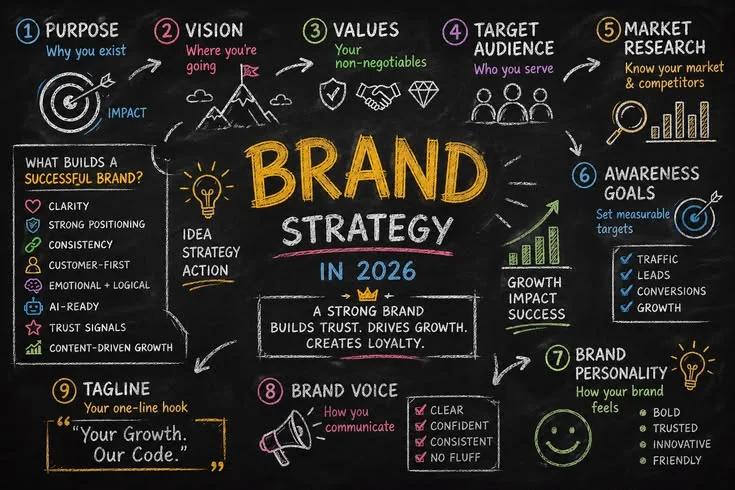
What Are the 7 Stages of the Branding Process? The 2026 Ultimate Guide
What are the 7 stages of the branding process? They are research and discovery, brand strategy, brand positioning, brand identity development, brand implementation, communication and engagement, and measurement and evolution. Together, these branding steps turn a business vision into an identity that customers recognize and trust, whether you are scaling a tech startup in Cairo, launching an e-commerce platform in Saudi Arabia, or building a corporate firm in Oman.
The branding process is much more than designing an attractive logo. It is a structured framework that aligns your vision with market reality, builds visual and verbal consistency, and turns target audiences into brand advocates. This guide explains each stage, what you should receive at the end of it, and the mistakes that most often derail brand creation projects.
What Is Branding? (Core Concepts Clarified)
Branding is the active process of researching, strategizing, designing, and managing the identity your company presents to the market. According to the Common Language Marketing Dictionary, which cites the American Marketing Association, a brand is any name, term, design, symbol, or other feature that sets one seller’s offer apart from the offers of other sellers.
Three distinctions prevent most early confusion:
- Brand vs. Branding: A brand is the emotional and perceptual identity your company holds in the customer’s mind. Branding is the work of building and managing that identity. If you want a deeper comparison, read how a brand differs from a logo with a practical example.
- Branding vs. Marketing: Branding defines who you are and what you stand for. Marketing covers the campaigns and tactics used to promote your offer. Branding sets the core message, and marketing carries it to the audience.
- Brand Identity vs. Brand Image: Brand identity is how your company chooses to present itself through its logo, tone of voice, and visual guidelines. Brand image is how the public actually perceives you. Closing the gap between the two is the main goal of the branding journey.
What Are the 7 Stages of the Branding Process at a Glance?
The 7 stages run from research, through strategy and design, to launch and ongoing measurement. The table below shows the focus and the main deliverable of each stage.
| Stage | Focus Area | Primary Deliverables |
|---|---|---|
| 1. Research & Discovery | Market analysis, competitor audits, buyer personas | Research report and brand audit |
| 2. Brand Strategy | Purpose, vision, values, and target audience | Brand strategy document and messaging framework |
| 3. Brand Positioning | Unique value proposition and differentiation | Positioning statement and perceptual map |
| 4. Brand Identity Development | Visual design, logo creation, typography, tone of voice | Brand style guide and asset pack |
| 5. Brand Implementation | Applying the identity across digital and physical touchpoints | Branded website, social assets, and packaging |
| 6. Communication & Engagement | Integrated media campaigns, content, and community building | Localized ad campaigns and WhatsApp conversation flows |
| 7. Measurement & Evolution | Tracking awareness and loyalty, and deciding on a refresh | Annual brand audit and performance KPIs |
Stage 1: Research and Discovery
Research and discovery is the stage where you collect objective facts about your market, customers, and competitors before any design decision is made. Skipping it leads to designs based on personal preference rather than market demand.
- Market and customer research: Identify audience demographics, buying triggers, and pain points across your target markets in Egypt and the Gulf Cooperation Council (GCC) countries.
- Stakeholder interviews: Talk to founders and leadership to map long-term goals and non-negotiables.
- Competitor analysis: Audit direct and indirect competitors to spot market gaps and unaddressed customer needs.
- Cultural context in Egypt and the Middle East and North Africa (MENA) region: Study local consumer behavior, cultural sensitivities, and dialect nuances.
- Brand audit: Evaluate existing brand assets, current market perception, and visual inconsistencies.
Stage 2: Brand Strategy
Brand strategy is the foundation that explains why your brand exists, who it serves, and how it behaves. Once the research is clear, you can define it with confidence.
- Brand purpose, vision, and mission: Articulate why your business exists beyond profit, where it is headed, and how it serves customers every day.
- Core values and personality: Choose the guiding principles that shape company culture, and give the brand a few distinct personality traits.
- Target audience definition: Build detailed buyer personas that shape sales copy and campaign messaging.
- Unique value proposition (UVP): Write a clear, concise statement of why customers should choose you over alternatives.
Stage 3: Brand Positioning
Brand positioning defines the space your company occupies in the customer’s mind relative to competitors. Through competitive matrix mapping and perceptual analysis, you establish a distinct market position that makes your brand the obvious choice in its niche.
For example, a hypothetical Egyptian beverage brand could position itself as a premium, healthy alternative in a market dominated by high-sugar sodas. A simple positioning statement keeps that choice sharp: “For [audience], [brand] is the [category] that [key difference], because [proof].” If you cannot fill every bracket with something true, the positioning is not ready for design.
Stage 4: Brand Identity Development
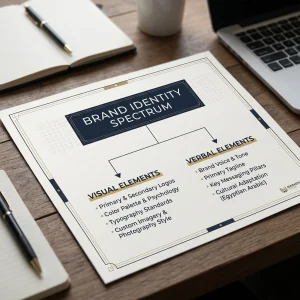
Brand identity development turns strategy into visual and verbal expression. This is where the logo design process, color palette, typography, imagery, and tone of voice take shape.
A typical logo design process moves through four steps: a creative brief, concept sketches, refinement of the chosen direction, and a final logo system with primary, secondary, and icon versions. A professional brand identity design service then extends that logo into a full system, while the elements of corporate identity and brand storytelling explain how the pieces work together.
The main deliverable is a brand style guide, also called brand guidelines. It documents logo usage, colors, typography, imagery, and voice, so every internal team member and external agency can keep the brand consistent across channels.
Stage 5: Brand Implementation
Brand implementation is the stage where the identity meets real customers on real touchpoints. Execution usually includes:
- Website and landing pages: Build fast, mobile-first pages that carry the identity clearly. Our website development service shows how this stage is structured.
- Social media ecosystem: Align Facebook, Instagram, LinkedIn, and TikTok profiles with unified graphics and brand messaging.
- Collateral and packaging: Design presentation decks, sales kits, product packaging, and office branding. The El Marmar project is an example of repackaging design for a food and beverage brand.
- Internal team alignment: Train employees and customer support staff to speak in the official brand voice before the public launch.
Stage 6: Brand Communication and Engagement
Brand communication and engagement is the stage where consistent, localized messaging builds brand equity over time. It has three practical parts.
1. Integrated media campaigns
Combine performance media buying with strategic storytelling. A well-run paid ads and PPC marketing program amplifies reach, while organic content builds familiarity. For a step-by-step view of the organic side, see how to build your brand on social media, and for regional context, review the latest social media trends in Saudi Arabia.
2. Egyptian Arabic and regional tone
Tone of voice should match the audience you are speaking to. Egyptian Arabic copywriting can feel more relatable for direct-to-consumer brands in Egypt, while formal Arabic or English usually suits B2B corporate audiences. Test the choice with real customers instead of assuming.
3. WhatsApp and conversational branding
WhatsApp is a core sales and customer care channel for many businesses in Egypt and the Gulf, so your brand voice must stay professional and responsive in direct chats. The scale of the audience is large: according to DataReportal, Egypt had about 51.6 million active social media user identities in October 2025. Conversational workflows, such as approved reply templates and clear handoff rules, keep the brand consistent in every one-to-one conversation.
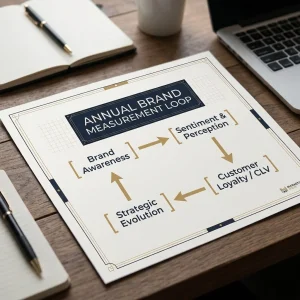
Stage 7: Brand Measurement and Evolution
Brand measurement and evolution is the stage where you track whether the brand is working and decide when it needs to change. Branding is a continuous asset that evolves alongside your market, not a one-time project.
- Tracking metrics: Monitor brand awareness, sentiment, customer lifetime value (CLV), engagement, and the growth of branded search over time. Strong SEO services in Egypt help you capture the demand that a stronger brand creates.
- Brand refresh vs. rebranding: A refresh is a minor visual update, while a rebrand is a complete overhaul of strategy and identity. Choose based on how far your brand has drifted from your business and your customers.
Rebranding Process Steps: How the 7 Stages Change
The rebranding process follows the same seven stages, but it starts from an existing brand instead of a blank page. Rebranding steps usually shift in three ways:
- Stage 1 becomes an equity audit: you decide which names, colors, and associations customers already value and should be kept.
- Stages 2 and 3 add a reason for change: leadership must agree on what has changed in the business, the market, or the audience.
- Stages 5 and 6 add a migration plan: legacy assets, signage, profiles, and listings must be replaced in a planned sequence and announced to customers.
Each of these rebranding process steps protects existing recognition while the new identity takes over.
Common Branding Mistakes to Avoid
The most common branding mistakes are skipping research, designing before positioning, and treating launch as the finish line.
- Starting with the logo: Visuals chosen before strategy reflect taste instead of market demand.
- Copying competitors: A look-alike brand gives customers no reason to choose you.
- Ignoring local language and culture: Messaging that ignores dialect or sensitivities loses trust quickly.
- Skipping guidelines: Without a style guide, every new designer and agency reinterprets the brand.
- Never measuring: Without metrics, you cannot tell a healthy brand from a drifting one.
How Long Does the Branding Process Take?
The timeline depends on company scale, how many stakeholders must approve decisions, and the scope of the project. The table below shows what drives the schedule for each type of business.
| Business Type | What Drives the Timeline | Primary Focus Areas |
|---|---|---|
| Small businesses and local brands | A small decision-making group and a focused scope | Core positioning, visual identity, website, and launch collateral |
| High-growth startups | Customer validation and the number of channels to set up | Customer validation, product packaging, and digital ecosystem setup |
| Corporate rebranding | Stakeholder alignment and the volume of legacy assets | Stakeholder alignment, legacy asset migration, and rollout |
How Much Does Branding Cost in Egypt?
Branding cost in Egypt depends on scope, not on a single standard price. The main factors are the depth of research, the number of identity applications, the number of markets you serve, and how many revision rounds the project includes. Ask every agency for a written list of deliverables per stage, so you can compare quotes on the same basis.
Why Choose Marketing House for Your Branding Journey?
Marketing House is a creative digital marketing agency in Egypt that combines brand strategy with performance marketing execution. As a brand creation company focused on corporate and B2B clients, we build localized, scalable identities that are designed to support qualified leads, not only a polished look. You can explore our full branding and visual identity services to see how each stage is delivered.
Ready to Build a Powerful Brand Identity?
Turn your business into a recognizable market leader with Marketing House.
Chat with a Branding Specialist on WhatsApp
Frequently Asked Questions (FAQs)
What is the most important stage of the branding process?
Research and Discovery is the most important stage. Without objective market data and customer insights, any visual design risks failing to connect with your target audience.
Is branding just designing a logo?
No, branding is much more than a logo. A logo is one visual symbol, while branding includes market research, positioning, brand voice, visual guidelines, customer experience, and ongoing messaging.
Should an Egyptian business brand in Arabic or English?
It depends on the target audience. B2B corporate brands often use English or formal Arabic, while direct-to-consumer brands in Egypt can benefit from Egyptian Arabic because it feels more relatable and engaging.
How does branding support search engine performance (SEO)?
A strong, recognizable brand can increase searches for the brand name, build user trust, and support higher click-through rates (CTR) on search results pages. Results vary by market and competition, so track branded search and CTR over time.
What is the difference between the 7 stages of branding and the 7 stages of marketing?
The 7 stages of branding build the identity, while marketing stages promote the offer. Branding answers who you are and why you matter, and marketing answers how you reach and convert customers with that identity.
How are rebranding steps different from branding steps?
Rebranding steps begin with an audit of the existing brand instead of a blank page. They add a reason for change and a migration plan so current recognition is protected during the transition.