Key Takeaways
- Social media is now the first place customers look. 49% of consumers use it to find new small businesses, ahead of search engines at 40% (Constant Contact, Small Business Now Q2 2026; survey of the US, UK, Canada, Australia and New Zealand).
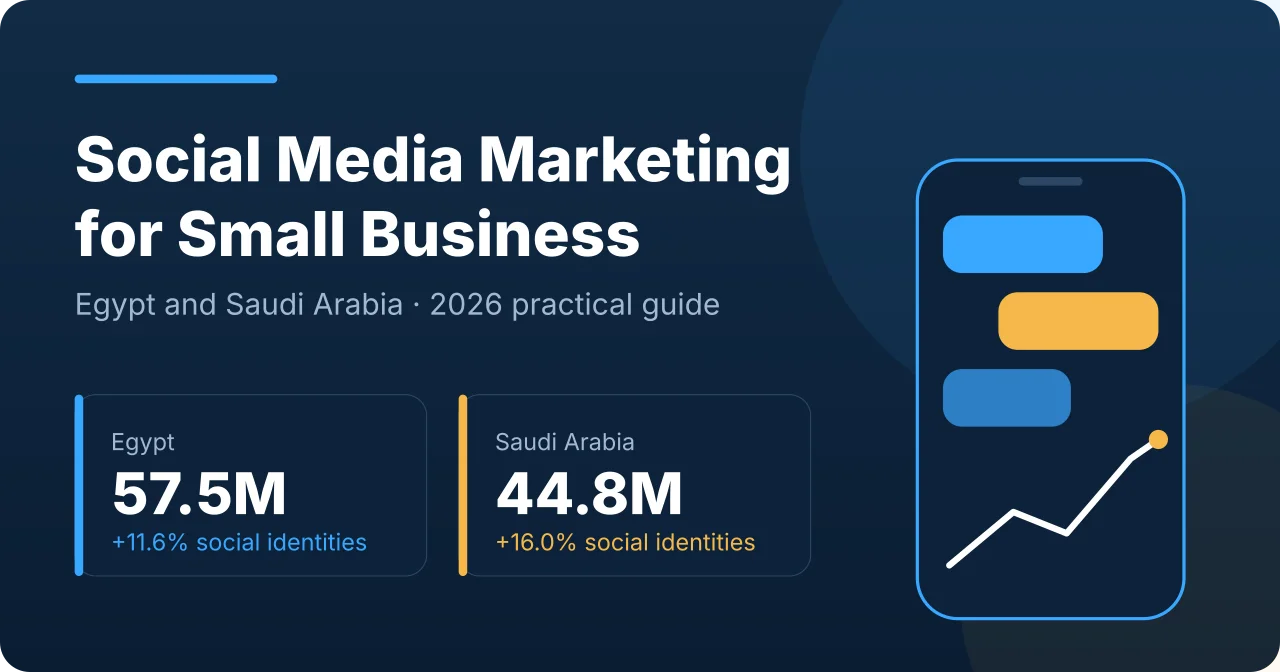
- The audience is large and growing. Egypt has 57.5 million social media user identities (+11.6% in a year); Saudi Arabia has 44.8 million (+16.0%) (DataReportal, Digital 2027, October 2026).
- Choose one or two platforms, not all of them. In Egypt, Facebook (87.7% monthly use) and WhatsApp (80.2%) lead; in Saudi Arabia, WhatsApp (86.7%), YouTube (83.7%), TikTok (81.9%), Instagram (75.7%) and Snapchat (74.4%) lead (GWI Q2 2026).
- Use an 80/20 content mix: 80% content that helps, entertains or proves; 20% direct promotion.
- Measure one goal at a time. ROI = (gain − cost) ÷ cost.
- Use AI to draft, then edit. AI saves time, but your Arabic dialect, facts and brand voice still need a human check.
What Are Social Media Marketing Small Business Strategies?
Social media marketing small business strategies are plans for using social platforms to reach a defined audience, build trust and turn attention into enquiries or sales, with a small team and a limited budget. A complete strategy answers five questions: who you are talking to, where they spend time, what you will post, how often you will post, and how you will know it works.
The case for doing this is strong. In Constant Contact’s Q2 2026 survey of 5,595 people (3,340 small businesses and 2,255 consumers, fielded April 2026), 49% of consumers said they use social media to discover new small businesses, versus 40% for search engines. The same survey found that 47% of small business owners manage all their social media themselves, so the plan has to be simple enough for one person.
That survey covers five Western markets. No comparable owner survey for Egypt or Saudi Arabia was found, so the next section uses local platform data instead.
Social Media in Egypt and Saudi Arabia in 2026: The Numbers Small Businesses Need
Egypt has the larger audience and Saudi Arabia has the faster connections. The table compares both markets using DataReportal’s Digital 2027 country reports (published 5 November 2026, data to October 2026).
| Metric | Egypt | Saudi Arabia |
|---|---|---|
| Population | 121 million | 35.3 million |
| Median age | 24.7 | 29.7 |
| Internet users | 99.0 million (82.2%) | 35.0 million (99.0%) |
| Social media user identities | 57.5 million (47.7% of population) | 44.8 million (127% of population) |
| Change in one year | +11.6% (+6.0 million) | +16.0% (+6.2 million) |
| Median mobile download speed | 52.32 Mbps (−7.5% in 12 months) | 224.54 Mbps (+15.6%) |
| Female share of social identities | 41.4% | 40.3% |
How to read these numbers:
- Saudi Arabia’s 127% is not a typo. DataReportal reports user identities, which can count one person on several platforms, so the figure can exceed 100% of the population. Use it as a sign of heavy multi-platform use, not as a headcount.
- Egypt’s mobile speed matters for video. At a median 52.32 Mbps and falling, short, compressed videos with on-screen captions load more reliably than long, heavy files. This is Marketing House’s practical inference from the speed data, not a measured result.
- Egypt is younger. A median age of 24.7 versus 29.7 suggests different content tone and platform mix for the same product.
Sources: DataReportal, Digital 2027: Egypt and Digital 2027: Saudi Arabia.
How to Create a Social Media Strategy for a Small Business?
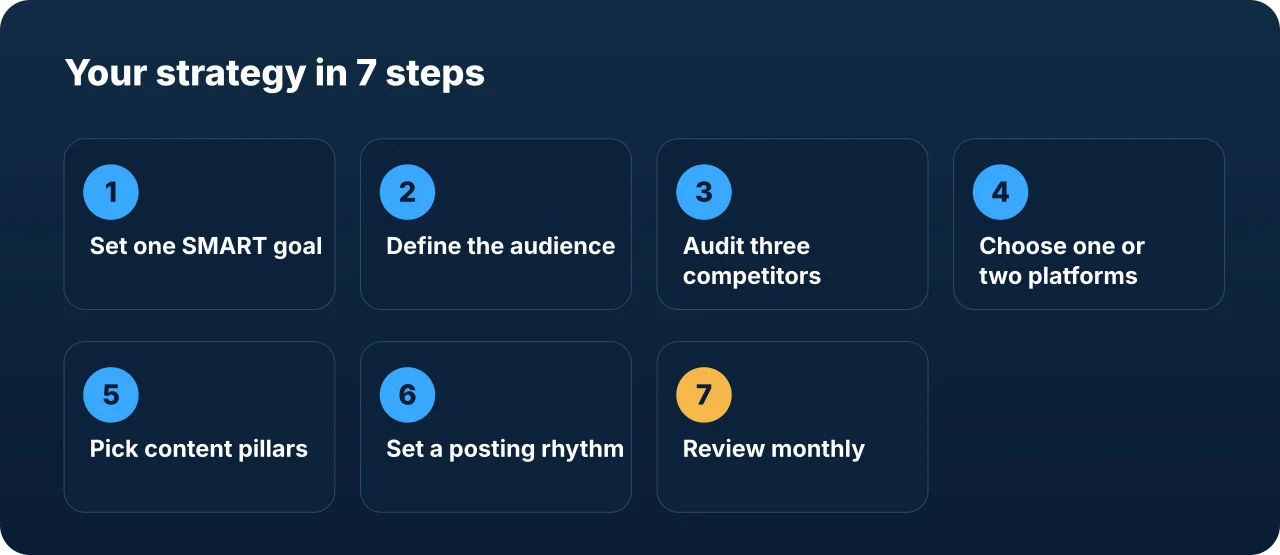
Create a social media strategy for a small business in seven steps: set one goal, define the audience, audit competitors, choose one or two platforms, pick content pillars, set a posting rhythm, and review monthly.
Step 1: Set one SMART goal
Choose one primary goal: awareness, website traffic, leads or sales. Make it specific, measurable, achievable, relevant and time-bound. Example: get 30 WhatsApp enquiries from Instagram within 60 days.
Step 2: Define the target audience
Write down who the customer is (age range, city, job or life stage), the problem they want solved, the platforms they use daily and the language or dialect they read. Build one to three simple buyer personas rather than a long list.
Step 3: Audit three local competitors
Spend 30 minutes on three competitors in your city. Note which platforms they use, how often they post, which formats get the most comments, and what they never talk about. The gaps become your content angles.
Step 4: Choose one or two platforms
Go deep on one or two platforms where your customers already are, instead of posting thinly everywhere. The next section shows the Egypt and Saudi Arabia usage data.
Step 5: Pick three or four content pillars
Content pillars are repeatable themes. A good starting set is education (tips and how-tos), proof (customer stories and results), behind the scenes (your team and process) and offers (products and promotions).
Step 6: Set a realistic posting rhythm
Choose a rhythm you can keep for 90 days, such as three posts a week plus daily Stories. Consistency beats bursts. See our guide to building a social media content plan.
Step 7: Review monthly with Test, Learn, Amplify
Treat organic posts as experiments. Test different hooks and formats, learn from the top 20% of posts, then amplify winners with more posts or paid support.
One-page strategy template
| Field | Your answer |
|---|---|
| Primary goal (SMART) | |
| Target audience and dialect | |
| Platforms (maximum two) | |
| Content pillars (three to four) | |
| Posting rhythm | |
| Main KPI | |
| Monthly budget | |
| Owner and review date |
For campaign ideas, read how to run a successful social media campaign.
Which Social Media Platforms Are Best for Small Businesses in Egypt and Saudi Arabia?
In Egypt, Facebook and WhatsApp lead; in Saudi Arabia, WhatsApp, YouTube, TikTok, Instagram and Snapchat lead. The table shows the share of internet users aged 16 and over who used each platform in the past month (GWI, Q2 2026, via DataReportal).
| Platform | Egypt | Saudi Arabia | Best small business use |
|---|---|---|---|
| 87.7% | 57.1% | Local customers, community groups, ads | |
| 80.2% | 86.7% | Enquiries, orders, customer support | |
| YouTube | 74.4% | 83.7% | Tutorials, reviews, long-form proof |
| TikTok | 71.6% | 81.9% | Discovery through short video |
| 68.5% | 75.7% | Visual products: food, fashion, beauty, services | |
| Telegram | 64.2% | 62.6% | Broadcast channels and groups |
| Snapchat | 42.8% | 74.4% | Reaching Saudi youth and adults |
| X | 37.3% | 65.4% | News, conversation, customer service |
| 22.5% | 35.0% | Ideas for home, fashion, weddings | |
| 25.5% | 28.6% | B2B leads, hiring, expertise | |
| Threads | 17.7% | 18.0% | Early-stage experiments |
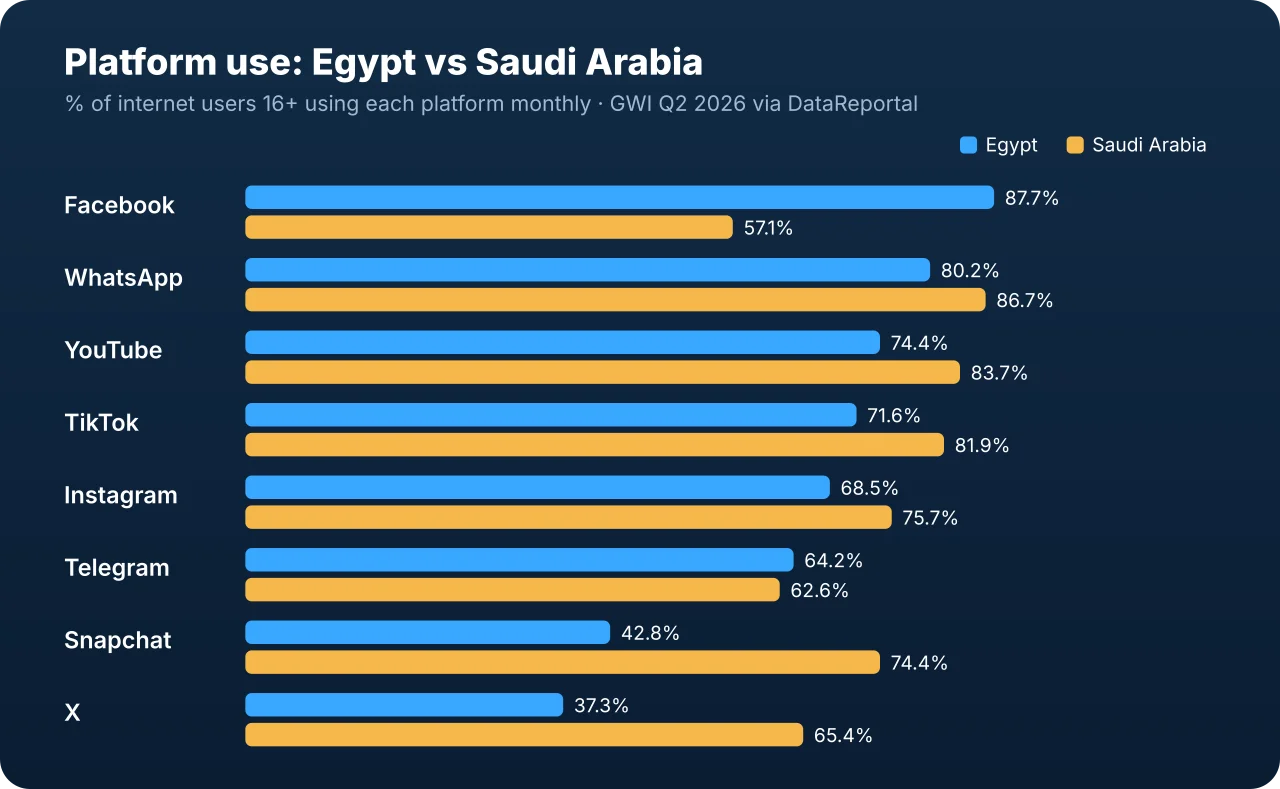
The biggest gaps between the two markets are Snapchat (31.6 points higher in Saudi Arabia), Facebook (30.6 points higher in Egypt) and X (28.1 points higher in Saudi Arabia). A copy-and-paste strategy across both countries will miss one audience.
Recommended starting pairs
These pairs are Marketing House’s recommendations based on the usage data above, not measured results.
- Egypt, local shop, restaurant or clinic: Facebook + WhatsApp.
- Egypt, fashion, beauty or food brand: TikTok + Instagram.
- Egypt, B2B or professional services: LinkedIn + Facebook. LinkedIn reports 20.0 million members in Egypt, up 33.3% in 2026.
- Saudi Arabia, retail and food: Snapchat + TikTok.
- Saudi Arabia, services and real estate: Instagram + WhatsApp.
- Saudi Arabia, B2B: LinkedIn (15.0 million members) + X.
WhatsApp and Snapchat: the platforms most guides skip
Most international guides ignore both. WhatsApp is used by 80.2% of Egyptian and 86.7% of Saudi internet users, so every post and ad should make it easy to start a WhatsApp chat. Snapchat’s ad tools show 26.6 million users in Saudi Arabia, equal to 92.0% of Saudi adults, while Egypt shows 22.0 million (21.3% of adults). Note that these are advertising reach estimates, not monthly active users. For Saudi trends in more depth, see social media trends in Saudi Arabia.
Who is actually on each platform?
Audience mix changes the message. Pinterest’s ad audience is 69.0% female in Egypt and 67.2% female in Saudi Arabia. Facebook’s adult ad audience in Saudi Arabia is 22.7% female and 75.6% male. Snapchat’s adult ad audience in Egypt is 56.7% female. Check each platform’s audience before you plan creative.
Reach by platform (ad-tool estimates, late 2026)
| Platform | Egypt | Saudi Arabia |
|---|---|---|
| YouTube | 53.1 million | 27.6 million |
| 51.0 million | 17.6 million | |
| TikTok (18+) | 57.5 million | 44.8 million |
| 22.0 million | 18.3 million | |
| Snapchat | 22.0 million | 26.6 million |
| X | 4.23 million | 13.5 million |
TikTok’s ad reach grew 18.0% in Egypt and 16.0% in Saudi Arabia between late 2025 and late 2026. Facebook’s reach fell slightly in both countries, but platform data corrections can cause apparent drops, so treat trends with caution. Source: DataReportal.
What Should a Small Business Post? The 80/20 Content Mix
Post content that helps, entertains or proves for 80% of your posts, and keep direct promotion to 20%. People follow businesses that are useful; they ignore feeds that read like a catalogue.
| Content type | What it looks like | Share of posts |
|---|---|---|
| Educational | Tips, how-tos, mini tutorials, FAQs | Part of the 80% |
| Proof | Customer stories, reviews, before and after | Part of the 80% |
| Behind the scenes | Team, process, preparing orders | Part of the 80% |
| Entertainment and trends | Relevant short videos, trending sounds | Part of the 80% |
| Customer content (UGC) | Reposting customer photos with permission | Part of the 80% |
| Thought leadership | Founder opinions, industry insight (strong for B2B) | Part of the 80% |
| Offers and calls to action | Promotions, product launches, booking links | The 20% |
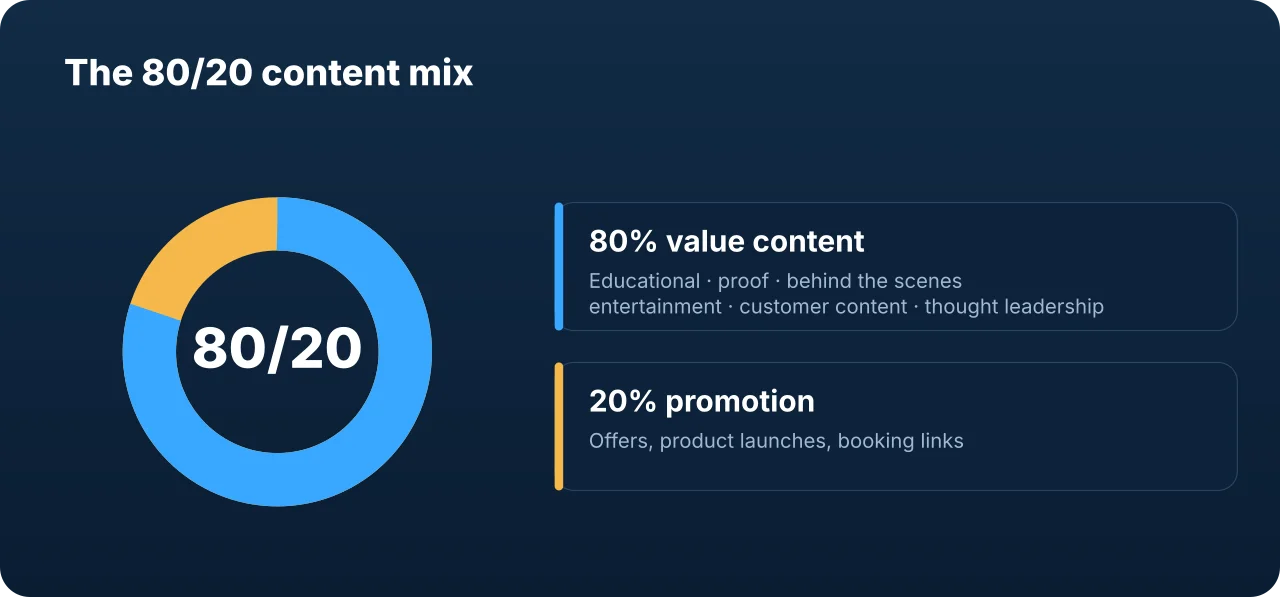
Sample week of five posts: two educational, one proof, one behind the scenes, one offer. That is four value posts and one promotion, or 80/20.
Two practical rules. First, prioritise short-form video where your chosen platform supports it, because TikTok, Instagram and YouTube all compete on video attention. Second, write in the dialect your customers use; Egyptian and Saudi audiences respond to different tones, so test before you standardise.
For brand-building formats, see how to build your brand on social media.
How to Plan and Schedule Social Media Content Without Burning Out?
Batch your content: plan once a month, create once a week, and schedule everything in advance. Because 47% of small business owners handle social media entirely alone (Constant Contact, Q2 2026), a repeatable routine matters more than ambition.
A simple time budget (Marketing House recommendation):
- Monthly, about 90 minutes: review last month’s results, choose the next month’s themes.
- Weekly, about 2 hours: shoot or design that week’s posts in one session.
- Daily, 10 minutes: reply to comments and messages.
Four-week calendar template
| Week | Focus | Example posts |
|---|---|---|
| 1 | Introduce and educate | Who we help, three common mistakes, FAQ video |
| 2 | Prove | Customer story, before and after, review screenshot |
| 3 | Engage | Poll, question box, behind-the-scenes day |
| 4 | Convert | Offer, limited slot, WhatsApp booking link |
Free scheduling is available in Meta Business Suite for Facebook and Instagram, and tools such as Buffer and Canva help with scheduling and design. Our full guide to social media content planning includes more formats.
How to Increase Social Media Engagement for a Small Business?
Increase engagement by replying fast, asking specific questions, showing real people and rewarding customers who post about you. Engagement rate is simply interactions ÷ reach (or followers) × 100.
- Reply quickly. Aim to answer comments and direct messages the same business day. Fast replies turn browsers into buyers.
- Ask one specific question per post, such as a choice between two options, instead of a vague ‘what do you think?’.
- Show people. Faces, hands and real workspaces outperform stock images in most small business accounts, so test them first.
- Share customer content (UGC). Ask permission, tag the customer and thank them publicly.
- Use polls and question boxes in Stories to start conversations.
- Move conversations to WhatsApp when a customer wants prices or availability.
- Capture contacts you own. Platforms change; a subscriber list does not. See how to build an email list from scratch.
How Can AI Help with Social Media Marketing for Small Businesses?
AI helps small businesses save time on ideas, drafts and repurposing, but a person must edit the final result. In Constant Contact’s Q2 2026 report, AI adoption in US small business marketing rose from 26% in 2023 to 87% by April 2026, and 50% of users worldwide said saving time is the main benefit. No equivalent Egypt or Saudi Arabia figure was found.
Good uses:
- Brainstorming 20 post ideas from one product or service.
- Drafting captions, then rewriting them in your voice.
- Turning one video or article into several posts.
- Summarising comments to find common questions.
Guardrails:
- Check every price, date and claim yourself.
- Have a native speaker review Arabic copy for dialect and tone.
- Never publish customer data in a public AI tool.
Should Small Businesses Combine Organic and Paid Social Media?
Yes. Use organic posts to test what your audience responds to, then put paid budget behind the posts that already work. Paid social buys speed and targeting; organic social builds trust and gives you free tests.
| Organic | Paid | |
|---|---|---|
| Main job | Build trust, test ideas | Scale winners, reach new people |
| Speed | Slow | Fast |
| Cost | Time | Time plus ad spend |
| Best for | Community, proof, education | Offers, lead forms, retargeting |
How to set a budget:
- Choose one goal (leads or sales).
- Pick two or three top-performing organic posts.
- Run them as ads with a small test budget you can afford to lose, for seven days.
- Calculate cost per lead = ad spend ÷ leads.
- Increase budget only on ads whose cost per lead is below what a lead is worth to you.
No published EGP or SAR benchmark for small business social ad budgets was found in the sources reviewed, and figures from US articles are quoted in dollars, so they do not transfer directly. Ask for a quote based on your sector and city. Learn about online advertising for small businesses.
How to Measure Social Media Marketing Success?
Measure the metric that matches your goal, and review it every month. The table links each goal to its key metrics.
| Goal | Metrics to track | Formula |
|---|---|---|
| Awareness | Reach, impressions, follower growth | Follower growth = new followers ÷ starting followers × 100 |
| Engagement | Likes, comments, shares, saves | Engagement rate = interactions ÷ reach × 100 |
| Traffic | Click-through rate (CTR), link clicks | CTR = clicks ÷ impressions × 100 |
| Leads | Cost per lead (CPL), form fills, WhatsApp chats | CPL = spend ÷ leads |
| Sales | Conversion rate, return on ad spend, ROI | ROI = (gain − cost) ÷ cost × 100 |
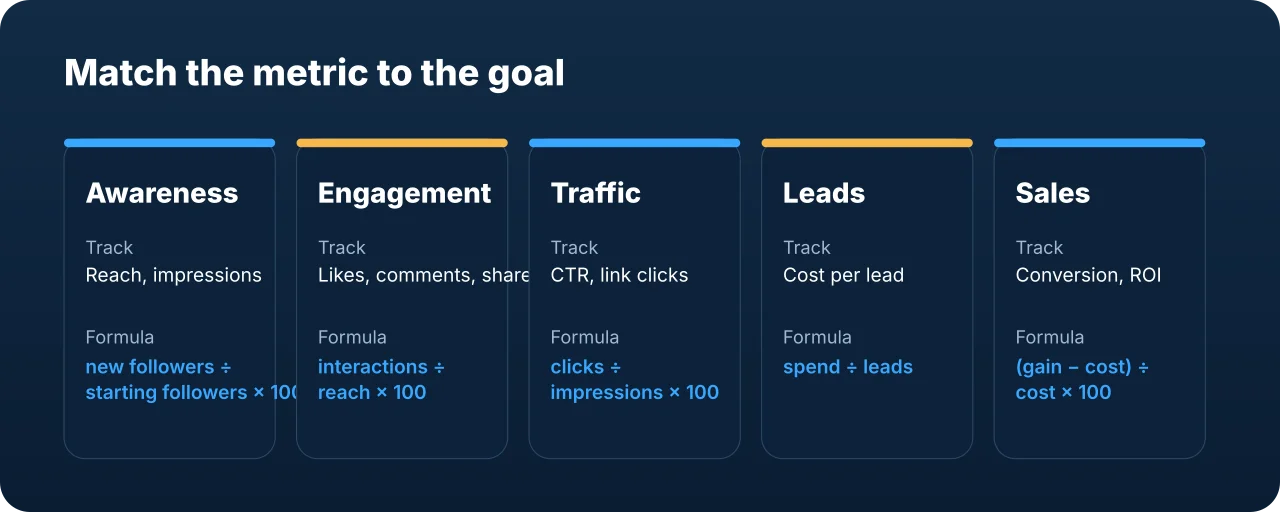
Worked example (illustrative numbers): you spend 6,000 and social media brings 24,000 in sales. ROI = (24,000 − 6,000) ÷ 6,000 = 3.0, or 300%.
Tracking tips:
- Add UTM parameters to every link so analytics show the source.
- Ask every new customer how they found you and record it.
- Compare the same period month over month rather than day to day.
For a wider KPI framework, see our marketing strategy guide.
What Are the Most Common Social Media Marketing Mistakes?
The most common mistakes are posting everywhere, having no goal, over-promoting, ignoring messages and never measuring results.
- Being on every platform instead of one or two.
- Posting without a goal or KPI.
- Promoting in more than 20% of posts.
- Leaving comments and direct messages unanswered.
- Using copied or generic content.
- Inconsistent posting, then long silences.
- Boosting random posts instead of proven winners.
- Ignoring analytics.
- Having no plan for criticism or a crisis.
A simple crisis protocol:
- Pause scheduled posts.
- Acknowledge the issue publicly and briefly.
- Move the detail to private messages or a phone call.
- Fix the problem, then report back publicly.
- Record what happened and update your process.
Social listening, meaning tracking mentions of your brand name and key terms, helps you spot problems early. Even a free saved search on each platform works.
When Should a Small Business Hire a Social Media Marketing Agency?
Hire an agency when social media is important to revenue but you lack the time, creative skills or data discipline to do it consistently. Keep it in-house when you have a team member with capacity and a clear strategy.
| Your situation | Best option |
|---|---|
| Owner is the only person and posting keeps slipping | Agency or hybrid |
| You have a creative employee and a clear plan | In-house |
| You sell in Egypt and Saudi Arabia and need local content | Agency with regional experience |
| You need paid ads and reporting | Agency or hybrid |
| Budget is very tight | In-house for 90 days, then reassess |
Marketing House supports businesses in Egypt, Saudi Arabia and Oman. See our Social Media Agency Egypt, browse our work, or contact us for a free quote.
Your 30-Day Social Media Action Plan
| Days | Action |
|---|---|
| 1–3 | Set one SMART goal; define audience; audit three competitors |
| 4–7 | Choose one or two platforms; set up profiles with a clear bio and WhatsApp link |
| 8–14 | Create three content pillars; batch your first two weeks of posts |
| 15–21 | Publish consistently; reply to every comment and message |
| 22–28 | Review results; identify the top three posts |
| 29–30 | Test paid support on the best post; plan next month |
Frequently Asked Questions
Sources and Methodology
- DataReportal, Digital 2027: Egypt and Digital 2027: Saudi Arabia, published 5 November 2026 (data to October 2026). Platform-use percentages come from GWI, Q2 2026. Reach figures come from platforms’ own ad tools and are not the same as monthly active users.
- Constant Contact, Small Business Now Q2 2026 (5,595 participants; US, UK, Canada, Australia and New Zealand; fielded April 2026), via PR Newswire and constantcontact.com.
- Recommendations marked as Marketing House recommendations are professional judgement, not survey findings.