
Business buyers in Egypt, Saudi Arabia, and Oman need more than higher search rankings. They want to find reliable suppliers, compare solutions, evaluate expertise, and identify partners who understand their commercial needs. A successful B2B SEO strategy helps your business become visible when potential customers are researching solutions and deciding whom to contact.
Choosing an SEO agency requires more than looking for a company described as the best-rated SEO company. Buyers should evaluate verifiable reviews, relevant experience, transparent reporting, and measurable business outcomes.
Marketing House SEO services focus on improving search visibility through technical optimization, useful content, and commercial search intent. This guide explains how B2B SEO works, what to consider when selecting an agency, and how businesses across the MENA region can approach traditional and AI-powered search.
Key takeaway: B2B SEO should connect search visibility with qualified inquiries and business objectives. Rankings and traffic are useful indicators, but they are not the final measure of success.
1. Why B2B SEO in Egypt, Saudi Arabia, and Oman Is Different
B2B buying journeys are often longer and more complex than consumer purchases. A business buyer may research suppliers, compare specifications, review implementation requirements, consult colleagues, and assess commercial risks before contacting a sales team.
This means B2B SEO needs to address different stages of the buying journey, from early research to vendor comparison and lead generation.
| SEO Area | Strategic Focus | Business Benefit |
|---|---|---|
| Search intent | Target relevant commercial and service-related searches. | Reach buyers looking for relevant solutions. |
| Technical SEO | Improve crawlability, indexing, site structure, and performance. | Help search engines discover important pages. |
| Content and authority | Publish useful guides, service pages, and credible resources. | Help buyers evaluate expertise and trustworthiness. |
| AI search readiness | Present accurate, structured, easy-to-understand information. | Make content easier for AI-powered systems to interpret. |
| Conversion optimization | Improve page messaging, forms, and contact options. | Help relevant visitors become qualified inquiries. |
Regional relevance matters, too. Businesses targeting Cairo may need different content priorities from those targeting Riyadh, Jeddah, Muscat, or Salalah. Keyword research, language choices, service availability, and local information should reflect the markets a company genuinely serves.
2. Our B2B SEO Process: From Research to Qualified Leads
An effective SEO program connects website improvements with buyer needs and measurable business objectives. A structured process helps teams prioritize the work most likely to improve visibility and user experience.
Step 1: Conduct a Technical and Competitor Audit
Review indexing, crawlability, page performance, site architecture, existing organic visibility, conversion barriers, and competitor content. Prioritize issues according to their likely impact rather than producing a long list of tasks without clear business context.
Step 2: Build an Intent-Led Keyword Strategy
Research commercial keywords, industry terminology, service-specific queries, and questions that arise during vendor evaluation. Map each important search intent to the most suitable page to reduce overlap and give users a clear destination.
Step 3: Develop Localized Arabic and English Content
Businesses serving multilingual markets may need content in professional English and formal business Arabic. Depending on the audience, useful assets can include detailed service pages, technical guides, industry articles, comparison pages, and case studies.
Step 4: Improve the Path from Visit to Inquiry
Review page messaging, calls to action, contact forms, mobile usability, and the information buyers need before contacting sales. Track meaningful actions such as qualified form submissions, relevant phone calls, and WhatsApp inquiries where applicable.
Step 5: Measure and Refine Performance
Use Google Search Console, Google Analytics 4 (GA4), and suitable CRM data to evaluate search performance and lead quality. Use the findings to improve existing pages, prioritize content opportunities, and plan further technical work.
SEO is a long-term process, and results vary according to competition, website condition, content quality, and implementation. Research from Ahrefs on how long pages take to rank illustrates why businesses should set realistic expectations rather than rely on promises of immediate rankings.
3. Local SEO for B2B Companies Across MENA
Local SEO is not limited to restaurants and retail stores. Industrial suppliers, logistics providers, professional service firms, and corporate vendors may also need to appear when potential customers search for relevant businesses in a particular area.
- Google Business Profile: Keep eligible business listings accurate, including business details, relevant categories, opening hours where applicable, and contact information.
- Consistent business information: Maintain consistent business names, addresses, and phone numbers across relevant directories.
- Authentic customer reviews: Encourage genuine clients to share their experiences and respond professionally to feedback.
- Useful location pages: Create pages for markets you genuinely serve, with meaningful local information instead of repetitive pages that only change the city name.
- Clear service coverage: Explain whether services are delivered locally, remotely, or through regional partners.
Searches such as “SEO company near me” indicate local intent. However, businesses should only claim locations and offices they can substantiate. Creating misleading local listings can undermine trust and create compliance problems.
For more practical guidance, read our local SEO guide.
4. Building Trust Through E-E-A-T and Verifiable Evidence
Trust plays an important role in B2B purchasing. Buyers may be evaluating a supplier that will handle substantial budgets, sensitive information, or essential business operations. Your website should provide evidence of expertise rather than rely on broad marketing claims.
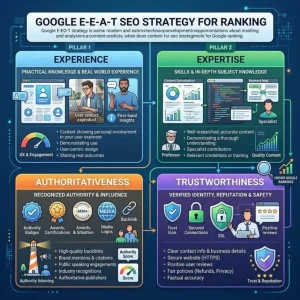
Google’s E-E-A-T framework refers to Experience, Expertise, Authoritativeness, and Trustworthiness. It is a quality framework, not a single score that guarantees search rankings.
- Expert authorship: Identify the author or reviewer of specialist content and explain relevant professional experience.
- Evidence-backed claims: Support factual statements with reliable sources and appropriate context.
- Transparent case studies: Explain the starting point, work performed, timeframe, and outcome when verified data and client permission are available.
- Clear company information: Make service details, contact information, policies, and business credentials easy to find.
- Website security: Maintain HTTPS, protect submitted information, and use appropriate privacy practices.
For content involving healthcare, finance, legal matters, or other areas that can significantly affect people’s lives, accuracy and suitable expert review are especially important.
5. AI Search Optimization (GEO) for B2B Businesses
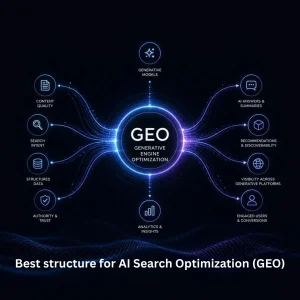
Generative Engine Optimization (GEO) describes efforts to make content easier for AI-powered search and answer systems to understand and potentially reference. It complements established SEO practices rather than replacing them.
For B2B companies, AI search can influence the research stage, when buyers compare services, explore technical concepts, and develop a shortlist of potential suppliers.
Practical ways to improve content clarity include:
- Answer questions directly: Begin important sections with a concise answer before providing additional context.
- Use descriptive headings: Organize content around clear topics, buyer questions, services, and problems.
- Demonstrate expertise: Provide accurate technical explanations, original insights, and verified examples where available.
- Maintain factual consistency: Keep company details and service descriptions consistent across the website and credible external sources.
- Implement relevant structured data: Use appropriate schema markup that accurately reflects visible page content.
- Prioritize reader value: Create genuinely helpful content instead of repeating keywords unnaturally.
Research from Semrush on Google AI Overviews examines the relationship between search intent and AI-generated results. The practical lesson is to address real research needs while recognizing that organic rankings and structured data do not guarantee inclusion in AI answers.
Important: No agency can guarantee a citation in an AI answer, an appearance in Google AI Overviews, or a specific organic ranking. A credible strategy focuses on useful content, technical accessibility, trustworthy information, and measurable progress.
6. Industry-Specific B2B SEO Strategies
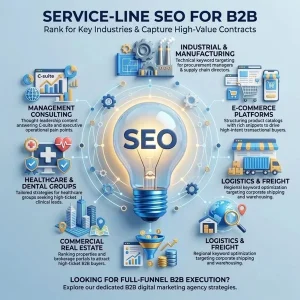
Different industries have different buyers, decision criteria, and conversion goals. SEO strategies should reflect these differences rather than apply the same template to every business.
Manufacturing and Industrial Suppliers
Build pages around product specifications, industrial applications, technical documentation, procurement needs, and relevant service regions. Measure qualified inquiries and requests for quotation (RFQs), not just page visits.
B2B E-Commerce
Organize product and category pages clearly, address duplicate-content risks, and use accurate product structured data where appropriate. Wholesale platforms may also need to explain account requirements, bulk ordering, and business pricing.
Logistics and Freight
Develop useful pages for actual shipping services, routes, warehousing solutions, and regions served. Track quote requests by service and market to understand which pages attract commercially relevant demand.
Commercial Real Estate
Make property, development, and project pages easy to discover and understand. Include accurate location details, relevant specifications, and clear inquiry options. Use structured data only where it matches the visible page content.
Healthcare and Dental Businesses
Distinguish between patient-facing services and B2B offerings such as dental equipment, laboratory services, and multi-clinic solutions. Each audience requires its own search intent, content, and conversion path.
Construction and Contracting
Explain project types, technical capabilities, certifications, service coverage, and relevant experience. Developers and facilities teams need enough information to assess suitability before contacting a contractor.
Management Consulting
Publish expert content addressing operational challenges, strategic decisions, and sector-specific issues faced by senior executives. Demonstrate real expertise rather than relying on generic business advice.
For a broader approach to business acquisition, explore our B2B digital marketing strategies.
7. Integrating LinkedIn With B2B SEO
LinkedIn can support B2B marketing by helping useful content reach professional audiences. Social engagement itself should not be presented as a confirmed direct Google ranking factor.
- Optimize professional profiles: Describe expertise and services using language that target buyers understand.
- Share original insights: Distribute useful articles, research, and commentary that link to relevant resources on your website.
- Support brand discovery: Help potential customers become familiar with your business and its expertise.
- Measure referral quality: Evaluate relevant visits, inquiries, and assisted conversions where tracking permits.
The goal is to connect professional visibility with useful website resources and a clear path toward a business conversation.
8. B2B Content That Supports the Buying Journey
Effective B2B content answers the questions that prevent potential customers from moving forward. It helps buyers understand a problem, evaluate approaches, compare providers, and decide what to do next.
- Industry guides and white papers: Explain complex topics with practical detail and credible sources.
- Case studies: Show the challenge, approach, timeframe, and measurable outcome when verified information is available.
- Comparison pages: Help buyers understand differences between solutions, approaches, or service models fairly.
- Service pages: Describe deliverables, suitable customers, scope, and next steps in clear language.
- Executive thought leadership: Address relevant market developments and operational challenges with informed analysis.
- Frequently asked questions: Answer genuine buyer questions concisely and accurately.
When using lead-generation forms, explain what visitors will receive and why the requested information is needed. Gated resources should provide enough value to justify the extra step.
9. Technical SEO Essentials for B2B Websites
Strong content needs a technically accessible website. Technical SEO helps search engines discover and interpret pages while supporting a reliable experience for visitors.
- Crawlability and indexing: Check robots directives, XML sitemaps, canonical tags, redirects, and unintended indexing issues.
- Site architecture: Organize service pages and supporting content into a logical structure with useful internal links.
- Performance and mobile usability: Improve loading performance, layout stability, and navigation across devices.
- Structured data: Use suitable Organization, Article, Breadcrumb, or Service-related markup where applicable.
- Security and reliability: Maintain HTTPS, monitor errors, and ensure contact forms work correctly.
- Conversion measurement: Test analytics events and lead tracking so reports reflect user actions as accurately as possible.
Technical priorities should be based on the website’s actual condition. Not every site needs the same fixes, and structured data alone does not guarantee enhanced search results.
If you are reviewing your website infrastructure, see our guide to WordPress website packages and pricing.
10. How to Evaluate B2B SEO Case Studies
Case studies can help you determine whether an agency’s experience is relevant to your business. A useful SEO case study explains the evidence behind its claims rather than presenting an impressive percentage without context.
Look for five essential details:
- Baseline: What were the site’s rankings, organic traffic, or lead results before the work began?
- Timeframe: Over what period were the results measured?
- Work performed: Which technical, content, authority, or conversion improvements were implemented?
- Business outcome: Did qualified inquiries, RFQs, opportunities, or another relevant metric improve?
- Measurement method: How were the results tracked, and were external factors considered?
For example, an industrial supplier may prioritize qualified RFQs, while a logistics company may focus on quote requests by service line. A commercial real estate business may measure qualified inquiries for individual properties.
You can review an example of Marketing House’s client work in the El-Khalifa Group project. This is a real estate website project and should not be treated as evidence of SEO performance unless separate, verified SEO results are available.
When assessing an agency, request evidence relevant to your industry and commercial objectives. Avoid relying on results that lack a baseline, timeframe, or clear explanation.
11. B2B SEO Pricing in Egypt, Saudi Arabia, and Oman
B2B SEO pricing depends on the work required, the markets targeted, and the complexity of the website. Ongoing programs may include technical improvements, content development, reporting, and continuous optimization, but the scope varies by provider.
Before comparing proposals, consider the following factors:
- Markets and languages: Targeting multiple countries and producing content in Arabic and English generally requires more work than a single-market campaign.
- Content requirements: Technical articles, service pages, case studies, and research-led resources have different production needs.
- Website complexity: Large product catalogs, multiple domains, and legacy systems may require additional technical resources.
- Competitive landscape: Competition for commercial keywords affects the amount and type of work required.
- Reporting requirements: Measuring qualified leads and sales opportunities may require CRM integration and additional tracking.
- Implementation responsibilities: Clarify whether the agency will implement technical fixes or provide recommendations for your development team.
Before signing a contract: Request a written scope of work, specific deliverables, reporting frequency, responsibilities, contract duration, and any additional fees. Compare proposals based on the work and its relevance to your business goals, not price alone.
There is no single price that fits every B2B SEO campaign. Request a tailored proposal based on your website, target markets, competition, and business objectives.
12. B2B SEO vs. LinkedIn Ads vs. Google Ads
SEO and paid advertising serve different purposes. The right combination depends on your timeline, audience, budget, and the amount of existing demand for your services.
| Channel | Main Strength | Best Used For | Cost Model |
|---|---|---|---|
| B2B SEO | Builds organic visibility and useful resources over time. | Long-term demand capture and ongoing discovery. | Agency or in-house costs, content, and technical implementation. |
| LinkedIn Ads | Professional audience targeting. | Reaching selected job roles, companies, and account-based audiences. | Paid media budget, commonly based on clicks or impressions. |
| Google Search Ads | Paid visibility for selected search queries. | Testing demand and reaching people actively searching for relevant services. | Advertising budget, commonly pay-per-click. |
For many B2B companies, these channels can work together. Paid campaigns can test messaging and capture demand while SEO develops organic visibility over time. Evaluate performance through lead quality and business outcomes as well as channel-specific metrics.
Explore our paid advertising and PPC marketing services for more information.
13. Common B2B SEO Mistakes to Avoid
- Focusing on traffic alone: More visits do not necessarily mean more qualified opportunities.
- Using the same strategy for every market: Language, competition, search behavior, and service availability can differ by region.
- Publishing generic content: Pages should answer real buyer questions and provide useful information beyond what competitors already offer.
- Ignoring conversion tracking: Without reliable tracking, it is difficult to connect organic activity with business inquiries.
- Creating repetitive location pages: Pages need distinct, useful information and must accurately represent the areas served.
- Overusing keywords: Repeating awkward phrases can harm readability and reduce trust.
- Accepting guaranteed rankings: No agency controls search engine algorithms or can guarantee a specific organic position.
- Neglecting maintenance: Search performance requires ongoing monitoring, updating, and technical care.
14. Measuring B2B SEO Success: Metrics That Matter
A useful reporting framework connects search visibility to what happens after visitors arrive. Select metrics that reflect your sales process and define how each one is calculated.
- Organic visibility: Track impressions, clicks, and relevant commercial keyword performance.
- Qualified leads: Measure inquiries that meet agreed criteria for relevance and potential fit.
- Conversion rate: Monitor the proportion of relevant website visits that result in a defined action.
- Cost per qualified opportunity: Compare SEO costs with the qualified opportunities they help generate, using a consistent attribution method.
- Pipeline contribution: Where reliable CRM data is available, examine how organic search contributes to sales opportunities.
- Landing page performance: Identify which pages attract relevant visitors and help them take the next step.
SEO attribution is not always straightforward, especially when buyers interact with multiple channels before contacting sales. Reports should explain their methodology and avoid attributing every outcome to a single channel without evidence.
15. How to Choose a B2B SEO Agency
The right agency should understand your business model, target buyers, competitive environment, and definition of a qualified lead. Its proposal should explain how work will be prioritized and measured.
Ask potential partners these questions:
- Can the agency explain its strategy in terms of our target buyers and business objectives?
- Can it provide relevant case studies with clear timeframes and verifiable metrics?
- How will technical SEO, content development, and conversion improvements be prioritized?
- How will the strategy address our target markets and language requirements?
- What deliverables will we receive, and how often will progress be reported?
- How will qualified leads and commercial outcomes be measured?
- What does the agency need from our internal marketing, sales, and development teams?
- Are the proposed scope, fees, responsibilities, and contract terms clearly documented?
Marketing House provides digital marketing and SEO services. Businesses considering a partnership should evaluate the proposed scope, relevant experience, reporting approach, and fit with their own objectives before making a decision.
Frequently Asked Questions About B2B SEO
What is B2B SEO?
B2B SEO is the process of improving a business website’s visibility for searches made by other businesses and professional decision-makers. It combines technical optimization, relevant content, search intent research, and conversion improvements to support qualified lead generation.
How long does B2B SEO take to produce results?
The timeframe depends on the website’s current condition, competition, authority, content quality, and implementation speed. Some technical improvements may have earlier effects, while competitive search terms often require sustained work over several months. No agency can reliably guarantee a fixed ranking date.
How is B2B SEO different from B2C SEO?
B2B SEO often targets specialized audiences, complex services, higher-value decisions, and longer sales cycles. B2C SEO more commonly addresses individual consumers and product purchases. Both require relevant content and a technically sound website, but their conversion goals and buyer journeys can differ.
Can SEO improve rankings quickly?
Some improvements, such as resolving indexing problems or correcting page titles, can help search engines understand a website more effectively. However, the timing and impact vary. Competitive visibility usually requires continued content, technical, and authority-building work.
Does local SEO help B2B companies?
Yes. Local SEO can help eligible businesses appear in relevant location-based searches and Google Maps results. Accurate business information, appropriate local pages, and authentic reviews can support discovery by regional buyers.
Can B2B SEO help a company appear in AI search results?
Clear, accurate, well-structured content can make information easier for search systems and AI tools to interpret. However, there is no guaranteed method for securing an AI citation or appearance. Strong technical SEO, useful content, and credible evidence remain important foundations.
How should I compare B2B SEO agencies?
Compare the proposed strategy, relevant experience, verified case studies, deliverables, reporting, communication, and contract terms. Ask how the agency will measure qualified leads and commercial outcomes rather than judging its proposal by rankings or traffic promises alone.
Ready to Improve Your B2B Search Strategy?
Understand your website’s current SEO performance, identify opportunities in your target markets, and prioritize improvements that support your business goals.
Contact Marketing House to discuss your website, target audience, and potential next steps.